Breaking into the German market can feel daunting when your web pages remain buried in Google.de search results. For Dutch e-commerce managers, understanding how SEO tags influence visibility is essential. These HTML elements, such as title tags and meta description tags, act as crucial signals for German search engines, setting the foundation for ranking and user attention. You will discover actionable ways to optimise these tags strategically, helping your products stand out in Germany and attract local customers.
Table of Contents
- SEO Tags Defined For Online Marketers
- Core Types Of SEO Tags And Their Roles
- How SEO Tags Impact Google.de Ranking
- Optimising SEO Tags For The German Market
- Common SEO Tag Mistakes To Avoid
Key Takeaways
| Point | Details |
|---|---|
| Understanding SEO Tags | SEO tags are essential for improving webpage visibility on search engines, especially on Google.de. Proper implementation helps search algorithms comprehend page content effectively. |
| Key Tag Types | Important SEO tags include Title Tags, Meta Description Tags, and Header Tags, each serving distinct roles in influencing search ranking and user engagement. |
| Optimisation for German Market | Localisation of tags with attention to native language and cultural context is critical for success in German-speaking regions like Germany, Austria, and Switzerland. |
| Common Mistakes | Digital marketers should avoid errors such as keyword stuffing and duplicate meta descriptions, which can harm search performance and site visibility. |
SEO Tags Defined For Online Marketers
Understanding SEO tags is crucial for digital marketers seeking visibility on Google.de and other German search platforms. These HTML elements provide critical information about webpage content to search engines, helping them understand and appropriately rank web pages.
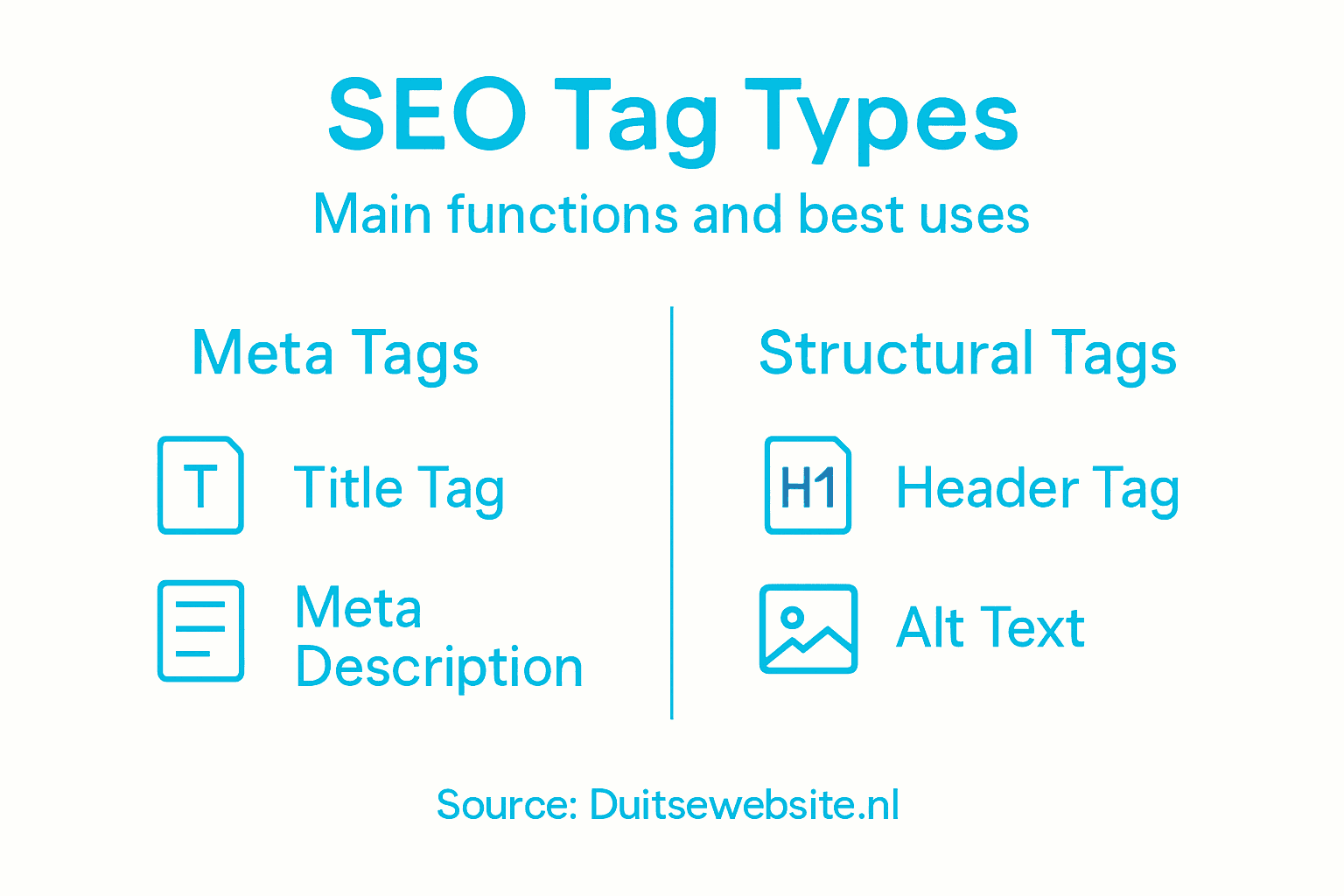
SEO tags are strategic HTML snippets located in a webpage’s header section that communicate essential page information. These tags serve multiple functions, helping both search engines and users comprehend webpage content. Meta tags inform search engines about critical page characteristics, acting as behind-the-scenes communication mechanisms.
Key SEO tags that online marketers should prioritise include:
- Title Tags: Serve as primary headlines in search results
- Meta Description Tags: Provide concise page summaries
- Robots Meta Tags: Guide search engine indexing processes
- Canonical Link Tags: Manage potential duplicate content issues
These tags work collectively to enhance search visibility and improve click-through rates. By strategically crafting these HTML elements, marketers can significantly influence how search engines interpret and display their webpages.
Pro tip: Regularly audit your website’s meta tags to ensure they accurately reflect current page content and optimise for target keywords.
Core Types Of SEO Tags And Their Roles
Search engine optimisation requires a strategic understanding of core HTML tags that communicate vital information to search algorithms. HTML SEO tags guide search engine interactions by providing critical signals about webpage content, structure, and relevance for ranking purposes.
The most essential SEO tags digital marketers must understand include:
- Title Tags: Create clickable headlines in search results
- Meta Description Tags: Summarise page content and encourage user clicks
- Heading Tags (H1-H6): Structure content hierarchy and improve readability
- Canonical Tags: Indicate preferred URL versions and manage duplicate content
- Robots Meta Tags: Control search engine indexing and link following
- Alt Text Tags: Provide image descriptions for accessibility and search understanding
Each tag serves a unique function in helping search engines comprehend webpage context. Title tags act as primary communication mechanisms, while meta descriptions offer concise summaries that can significantly influence click-through rates. Heading tags further help search engines understand content structure and importance.
Effective SEO tag implementation requires precise, strategic HTML configuration that balances technical requirements with user experience considerations.
Pro tip: Conduct regular SEO tag audits to ensure your HTML elements accurately represent current page content and align with target keyword strategies.
How SEO Tags Impact Google.de Ranking
Search engine performance on Google.de critically depends on strategic implementation of technical SEO elements. Page-level ranking factors directly influence search visibility through precise HTML tag configuration that helps search algorithms understand webpage relevance and context.
The key SEO tags that significantly impact Google.de ranking include:
- Title Tags: Communicate primary page topic
- Meta Description Tags: Provide contextual page summaries
- Header Tags (H1-H6): Establish content hierarchy
- Canonical Tags: Prevent duplicate content penalties
- Alt Text Tags: Enhance image search understanding
- Hreflang Tags: Signal language and regional targeting
Specifically for the German market, understanding nuanced tag implementation becomes crucial. Title tags must include relevant keywords positioned strategically to improve click-through rates, while meta descriptions should be crafted in native German to resonate with local search users. Heading tags further assist Google in comprehending content structure and semantic relationships.
Here’s a summary of how key SEO tags contribute to search engine performance and user experience:
| SEO Tag Type | Aids Search Engine Understanding | Enhances User Experience |
|---|---|---|
| Title Tag | Sets main topic and relevance | Provides visible headline |
| Meta Description | Supplies context for ranking signals | Improves click-through appeal |
| Header Tags (H1–H6) | Outlines content structure for crawling | Organises text for readability |
| Canonical Tag | Resolves duplicate content issues | Ensures correct page shown |
| Alt Text | Describes images for better indexing | Enables accessibility for images |
| Hreflang Tag | Specifies regional/language targeting | Directs users to local content |
Successful Google.de ranking requires a holistic approach that balances technical optimization with high-quality, regionally relevant content.
Pro tip: Develop a systematic approach to tag optimisation by creating a comprehensive audit checklist that covers all critical SEO tag elements for German-language websites.
Optimising SEO Tags For The German Market
Successful SEO strategies for Google.de demand a nuanced approach that goes far beyond simple translation. SEO tactics for German-speaking markets require deep localisation of technical elements, with particular attention to language subtleties and regional search behaviours.
Key considerations for optimising SEO tags in the German market include:
- Language Precision: Use native German terminology
- Regional Dialect Awareness: Accommodate variations across Germany, Austria, and Switzerland
- Cultural Context: Align metadata with local search expectations
- Technical Compliance: Adhere to strict German data protection regulations
- Keyword Localisation: Incorporate region-specific search terms
- URL Optimization: Avoid special characters that complicate indexing
Specifically, title tags and meta descriptions must be crafted with exceptional care. German users typically prefer detailed, informative metadata that provides clear context. This means constructing tags that are not just keyword-rich, but also semantically meaningful and aligned with local communication styles.

For digital marketers targeting Germany, Austria, and Switzerland, consider these region-specific tag optimisation tips:
| Optimisation Focus | Why It Matters for DACH Markets | Implementation Advice |
|---|---|---|
| Language Localisation | Increases native user engagement | Always use standard German or local dialects |
| Regional Search Intent | Matches user behaviours | Research locally trending keywords |
| Data Compliance | Meets legal requirements | Align metadata with GDPR best practices |
| Cultural Context | Builds trust with users | Adapt tone to regional preferences |
Effective German market SEO requires understanding linguistic nuances that extend beyond mere word-for-word translation.
Pro tip: Conduct comprehensive keyword research using native German sources and consult local SEO experts to ensure your tag optimisation strategy resonates authentically with German search audiences.
Common SEO Tag Mistakes To Avoid
Search engine optimization requires meticulous attention to detail, particularly when implementing HTML tags. Common SEO tag errors can significantly undermine website performance, potentially reducing visibility and compromising search rankings across Google.de and other platforms.
The most critical SEO tag mistakes digital marketers should avoid include:
- Keyword Stuffing: Overloading tags with excessive keywords
- Duplicate Meta Descriptions: Using identical descriptions across multiple pages
- Neglecting Header Tags: Failing to structure content hierarchically
- Missing Alt Attributes: Omitting image description tags
- Inconsistent Canonical Tags: Improperly managing duplicate content signals
- Ignoring Mobile Optimization: Not adapting tags for mobile search experiences
Properly structured SEO tags communicate clear signals to search algorithms. Keyword integration should feel natural and contextual, avoiding mechanical or forced insertions that might trigger search engine penalties. Each page requires unique metadata that accurately represents its specific content and purpose.
Successful SEO tag implementation demands a strategic approach that balances technical precision with user-focused communication.
Pro tip: Conduct regular comprehensive tag audits using professional SEO tools to identify and rectify potential optimization gaps before they impact search performance.
Unlock Your Google.de Potential with Expert SEO Tag Optimisation
Mastering SEO tags is not just about ticking boxes. This article highlights how precise use of title tags, meta descriptions, canonical tags and hreflang tags can directly influence your visibility on Google.de. If you are a Dutch business struggling to break into the German market, you understand the distinct challenges of linguistic nuances and technical SEO intricacies.
Do not let common mistakes like duplicate meta descriptions or missing alt tags hold you back. Our specialised agency offers tailored solutions that address these exact pain points by combining native German expertise with over 17 years of experience. With personalised strategies, you will see how optimising your site’s SEO tags leads to better search rankings and greater user engagement.
Ready to elevate your website’s German search performance? Discover how Geen categorie Archives provides insights that complement this knowledge.
Transform your SEO tag strategy today by partnering with Duitsewebsite.nl. Visit our homepage to explore our comprehensive digital marketing services designed specifically for Dutch companies aiming to succeed on Google.de. Take the next step and make your mark in the German market now.
Frequently Asked Questions
What are SEO tags and why are they important?
SEO tags are HTML elements in a webpage’s header that provide essential information about the content to search engines, helping improve visibility and ranking on search engines like Google.
How do title tags impact search visibility?
Title tags serve as clickable headlines in search results, directly influencing both search engine understanding of page topics and user click-through rates.
What should I include in a meta description for better SEO?
A well-crafted meta description should provide a concise summary of the page content, include relevant keywords, and be compelling enough to encourage users to click through to your site.
How do I optimise SEO tags for better performance?
To optimise SEO tags, ensure they are unique for each page, use relevant keywords naturally, and adhere to best practices for structure and compliance, such as avoiding keyword stuffing and managing duplicate content.
Recommended
- SEA versus SEO Duitsland: Uw Complete Gids – Duitsewebsite.nl
- Hoe Werkt Google.de: Uw Complete Uitleg – Duitsewebsite.nl
- SEO vs SEA Duitsland: De Essentiële Gids Voor 2024 – Duitsewebsite.nl
- SEO Duitsland: Een specialisme! 17jr ervaring. – Duitsewebsite.nl
- Content Trustworthiness: Impact on SEO and Authenticity