Archiefartikel · oorspronkelijk gepubliceerd op 2026-02-16. Informatie en verwijzingen kunnen inmiddels gewijzigd zijn.
Expanding into Germany can feel daunting when every transaction affects your bottom line. PayPal fees have become a crucial concern as German competition authorities examine whether these charges restrict pricing flexibility for merchants. With standard rates ranging from 2.49 percent to 2.99 percent plus fixed fees, Dutch SME e-commerce managers face real decisions about product pricing and profit margins. This overview uncovers the key fee structures that shape payment costs, equipping you to plan clearly and avoid costly surprises.
Table of Contents
- PayPal Fees in Germany Explained
- Types of PayPal Charges for Merchants
- How PayPal Calculates Transaction Costs
- Tax Implications and Compliance Duties
- Reducing PayPal Costs and Common Pitfalls
Key Takeaways
| Point | Details |
|---|---|
| Understanding PayPal Fees | PayPal’s fees for merchants in Germany include a percentage fee of 2.49% to 4.49% and a fixed fee per transaction of approximately €0.35, impacting profit margins significantly. |
| Types of Transactions Matter | Different transaction types incur varying fees; domestic transactions are cheaper, while international ones are typically more expensive, emphasising the need for careful categorisation. |
| Tax Compliance is Essential | Violating tax obligations, such as VAT reporting and proper record-keeping, can lead to fines and legal repercussions for Dutch SMEs operating in Germany. |
| Cost Reduction Strategies | SMEs should optimise transaction types and negotiate based on volume to minimise PayPal fees and improve overall profitability. |
PayPal Fees in Germany Explained
For Dutch SME retailers eyeing the German market, understanding PayPal transaction fees is crucial for accurate financial planning. German competition authorities have been scrutinising PayPal’s merchant fee structures, highlighting the complexity of payment processing costs in the German e-commerce landscape.
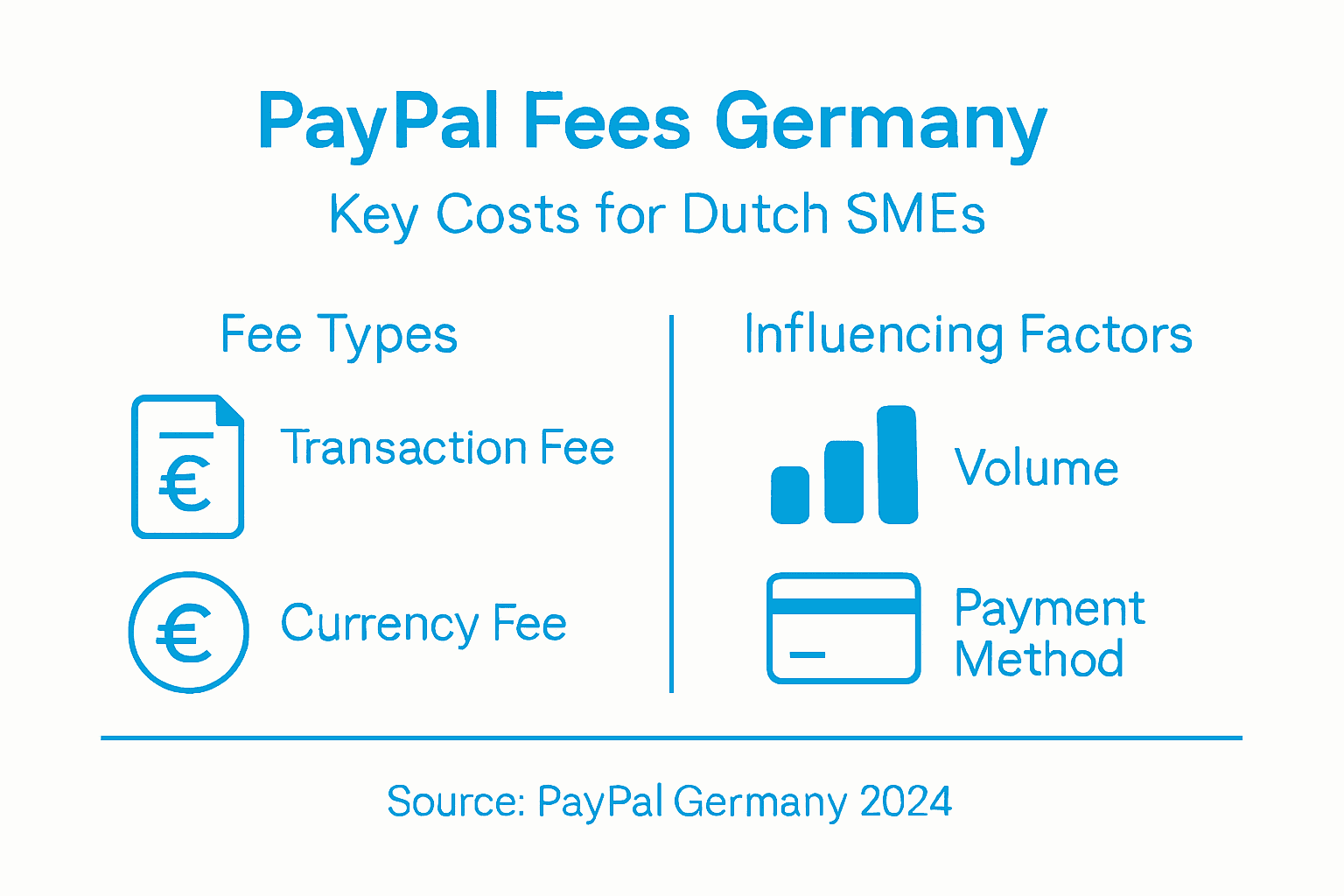
PayPal’s standard fee structure for merchants in Germany typically involves two key components:
- A percentage-based transaction fee (2.49% to 2.99%)
- A fixed fee per transaction (approximately 34-39 cents)
These fees can significantly impact your profit margins, especially for businesses processing high volumes of transactions. PayPal’s official fee schedule indicates that domestic commercial transactions are charged around 2.49% plus 0.35 EUR per transaction.
Specifically for Dutch SMEs expanding into Germany, it’s essential to factor these costs into your pricing strategy. The fees can vary depending on transaction type, payment method, and whether the transaction is domestic or international within the European Economic Area. Currency conversion can also trigger additional charges, so understanding the nuanced fee structure is paramount.
Pro Tip: Always calculate your total transaction costs by running sample transactions to understand the exact impact on your profit margins.
Types of PayPal Charges for Merchants
Dutch SME retailers navigating the German e-commerce landscape must understand the nuanced PayPal fee structures that can significantly impact their profitability. Merchant transaction fees in Germany are complex, with multiple charging categories depending on transaction type and payment method.
PayPal’s merchant charges typically fall into several distinct categories:
- Domestic Transaction Fees: Approximately 2.49% plus €0.35 per transaction
- International Transaction Fees: Higher percentage rates (often 3.49% to 4.49%)
- Charity Transaction Fees: Reduced rates around 1.5% plus €0.35
- Micropayment Fees: Variable rates for smaller transaction amounts
- Alternative Payment Method Fees: Different percentage charges based on payment type
The variation in fees reflects the complexity of PayPal’s pricing model. Payment method calculators can help merchants estimate precise costs, which fluctuate based on transaction volume, account type, and specific commercial agreements.
To better understand the fee differences, see how PayPal charges vary by transaction type for German merchants:
| Transaction Type | Typical Percentage Fee | Fixed Fee | Common Use Case |
|---|---|---|---|
| Domestic Commercial | 2.49% | €0.35 | Local online sales |
| International (EEA) | 3.49% – 4.49% | €0.35 | Cross-border purchase |
| Charity | 1.5% | €0.35 | Donations |
| Micropayment | Variable (lower %) | Lower fixed fee | Small-value sales |
| Alternative Payment Method | Varies by method | Typically €0.35 | e.g., SOFORT, Giropay |
For Dutch businesses expanding into Germany, understanding these nuanced fee structures is critical. Currency conversion, cross-border transactions, and specific payment method selections can trigger additional charges, making careful financial planning essential for maintaining competitive pricing and profit margins.

Pro Tip: Regularly review your transaction types and volumes to negotiate more favourable rates with PayPal, potentially reducing your overall payment processing expenses.
How PayPal Calculates Transaction Costs
For Dutch SME retailers operating in the German market, understanding transaction fee calculations is crucial for maintaining profitability. Fee calculation methods involve a sophisticated approach that combines percentage-based and fixed-fee components.
PayPal’s transaction cost calculation typically follows a standard formula:
- Percentage Fee: A variable rate based on total transaction amount
- Fixed Fee: A standard per-transaction charge (€0.35 in Germany)
- Total Fee: Percentage Fee + Fixed Fee = Complete Transaction Cost
The specific calculation method includes several critical considerations:
- Identify the transaction type (commercial, charity, international)
- Apply the appropriate percentage rate
- Add the fixed transaction fee
- Calculate the total cost deducted from the payment
Online fee calculators enable merchants to precisely estimate their transaction expenses. These tools allow Dutch businesses to input specific transaction amounts and immediately see the exact fees they’ll incur, helping with accurate financial planning and pricing strategies.
Currency conversion, transaction origin, and payment method can all influence the final fee calculation. For Dutch SMEs, this means carefully monitoring transaction characteristics to minimise unexpected costs and maintain competitive pricing in the German market.
Pro Tip: Create a spreadsheet template to track your PayPal transaction fees, enabling quick and accurate cost projections for different sales scenarios.
Tax Implications and Compliance Duties
Dutch SME retailers expanding into the German market must navigate complex tax compliance requirements when using PayPal for transactions. Merchant tax obligations encompass multiple layers of financial reporting and regulatory adherence.
Key tax considerations for PayPal transactions include:
- VAT Reporting: Mandatory for all commercial transactions
- Income Declaration: All PayPal payments count as business income
- Record-Keeping: Comprehensive documentation of all transactions
- Tax Filing: Precise reporting of digital payment revenues
- Cross-Border Compliance: Additional requirements for international sales
German tax regulations require meticulous attention to several critical aspects of financial reporting. Merchants must understand that PayPal serves only as a payment processor, leaving full tax compliance responsibility on the business itself.
Specifically for Dutch businesses, this means developing robust accounting systems that can:
- Track all PayPal transactions separately
- Calculate accurate VAT obligations
- Maintain detailed digital and physical transaction records
- Prepare comprehensive tax documentation
- Ensure timely and accurate tax submissions
The complexity of German tax law demands proactive management. Currency conversions, international sales, and varied transaction types can significantly impact tax calculations, making professional accounting support often necessary for Dutch SMEs operating in the German market.
For Dutch businesses operating in Germany, consider these key compliance actions and their impacts:
| Compliance Action | Business Purpose | Impact of Non-Compliance |
|---|---|---|
| VAT Reporting | Legal tax collection and payment | Fines, legal penalties |
| Detailed Record-Keeping | Proof for audits and financial reports | Inaccurate tax filings, penalties |
| Income Declaration | Accurate income reporting | Underpayment issues, audits |
| Timely Tax Submission | Meeting filing deadlines | Late fees, increased scrutiny |
| Separate PayPal Tracking | Transparent payment processing | Confused accounting, missed claims |
Pro Tip: Invest in specialised accounting software that integrates directly with PayPal to automate transaction tracking and simplify tax reporting processes.
Reducing PayPal Costs and Common Pitfalls
Dutch SME retailers expanding into Germany must strategically approach PayPal transaction management to minimise unnecessary expenses. Merchant fee challenges are complex, requiring careful navigation of payment processing strategies.
Key strategies for reducing PayPal costs include:
- Transaction Type Optimisation: Classify payments strategically
- Volume-Based Negotiations: Leverage transaction volumes for better rates
- Alternative Payment Methods: Explore diverse payment channel options
- Precise Transaction Categorisation: Utilise lower-fee transaction classifications
- Regular Fee Structure Review: Continuously monitor and analyse fee schedules
Fee calculation techniques reveal several common pitfalls that Dutch businesses must avoid:
- Overlooking fixed transaction fees
- Ignoring currency conversion costs
- Failing to understand tiered pricing structures
- Not accounting for international transaction premiums
- Neglecting to challenge or negotiate fee rates
The complexity of PayPal’s fee structure demands proactive financial management. Dutch SMEs must develop sophisticated tracking mechanisms to understand precisely how each transaction impacts their overall financial performance, ensuring they’re not inadvertently losing profits through inefficient payment processing.
Pro Tip: Create a comprehensive monthly spreadsheet tracking all PayPal transactions, categorising fees by type and identifying potential optimisation opportunities.
Navigate PayPal Fees in Germany with Confidence and Grow Your Business
Expanding your SME into Germany comes with complex challenges like mastering PayPal’s detailed fee structures and tax compliance requirements. Understanding every percentage fee, fixed charge, and currency conversion cost is vital to protect your profit margins and maintain competitive pricing. Dutch retailers looking to thrive in the German market need more than just payment insight—they need a strategic digital partner to maximise visibility and sales success.
At Duitsewebsite.nl, we specialise in empowering Dutch businesses to overcome these financial and marketing hurdles using proven online marketing services tailored for Germany. With over 17 years of native German expertise, our full-service solutions include SEO for Germany, Google Ads, Amazon marketing, webshop development, and localisation. Together we ensure your brand stands out despite complex transaction costs and regulatory demands. Visit our homepage to start your journey and discover how our personalised approach can help you optimise every aspect of your German expansion including navigating PayPal fees efficiently. Don’t let payment complexities hold you back. Contact us today and turn costly challenges into competitive advantages.
Frequently Asked Questions
What are the standard PayPal fees for merchants?
PayPal’s standard fees for merchants typically consist of a percentage-based transaction fee ranging from 2.49% to 2.99%, plus a fixed fee of around €0.34 to €0.39 per transaction.
How does PayPal calculate transaction costs for businesses?
PayPal calculates transaction costs by adding a percentage fee, based on the total transaction amount, to a fixed fee per transaction. For example, in Germany, this fixed fee is approximately €0.35.
Are there strategies for reducing PayPal fees?
Yes, merchants can reduce PayPal fees by optimising transaction types, negotiating better rates based on transaction volumes, exploring alternative payment methods, and continuously reviewing their fee structures.
What are the tax compliance requirements for using PayPal?
Tax compliance requirements include VAT reporting for all commercial transactions, accurate income declaration, comprehensive record-keeping, and timely tax submission to meet regulatory obligations.