Archiefartikel · oorspronkelijk gepubliceerd op 2026-02-16. Informatie en verwijzingen kunnen inmiddels gewijzigd zijn.
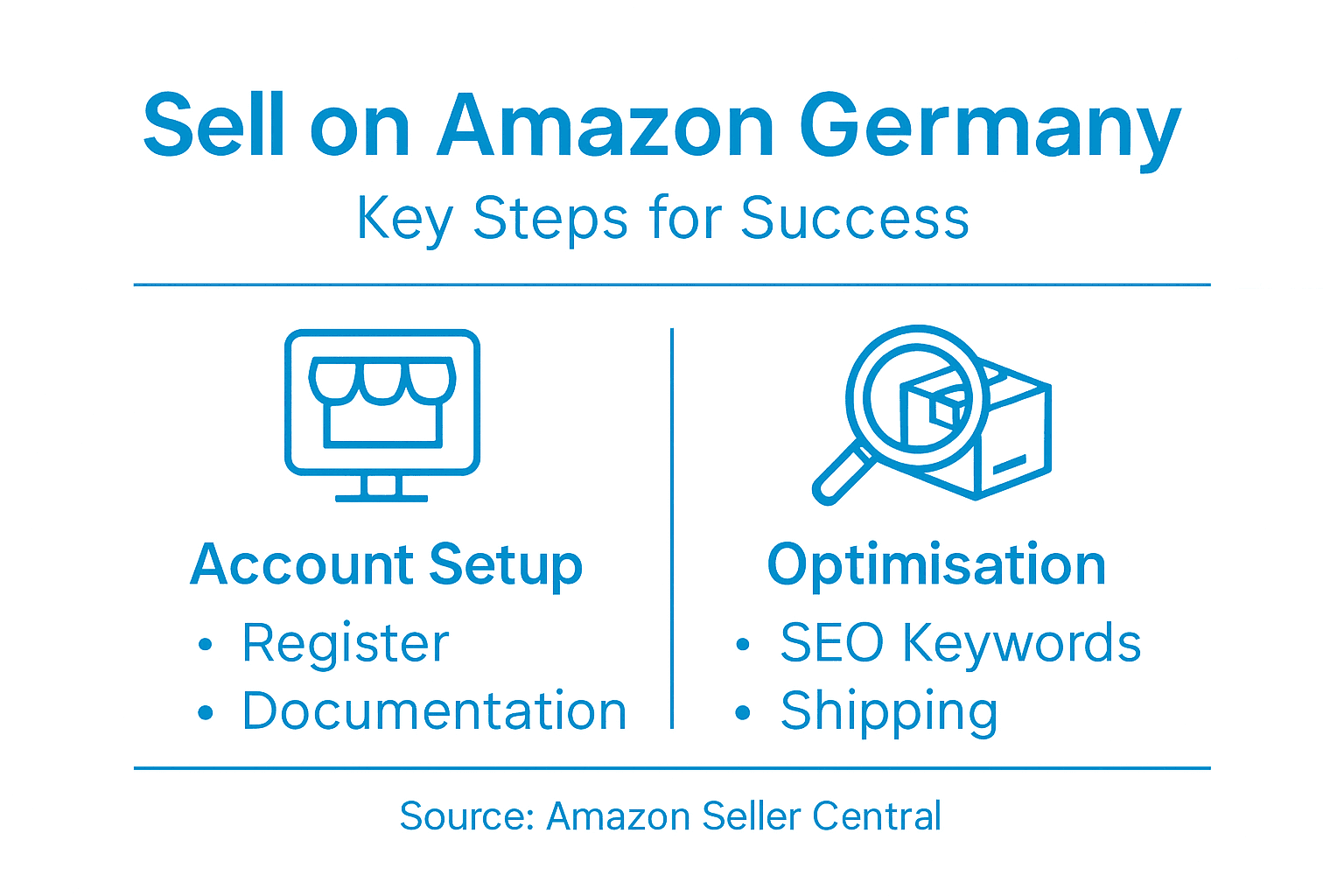
Expanding your online shop to Amazon Germany can feel overwhelming with all the technical details and cultural adaptation required. For Dutch e-commerce managers, entering such a large European market promises new growth yet demands careful preparation around registration, localisation and keyword research. This guide offers actionable steps and highlights the importance of precise product categorisation and comprehensive information so you can confidently list your products, optimise visibility and provide German customers with quality experiences.
Table of Contents
- Step 1: Set Up Your Amazon Seller Account For Germany
- Step 2: Localise Product Listings For The German Market
- Step 3: Optimise SEO And Keywords For Amazon.de
- Step 4: Manage Fulfilment And Shipping Efficiently
- Step 5: Verify Performance And Refine Your Selling Strategy
Quick Summary
| Key Message | Explanation |
|---|---|
| 1. Set up a professional seller account | Establish your Amazon Seller account on Amazon.de with required documents for smooth registration. |
| 2. Localise product listings effectively | Tailor product descriptions for German consumers by addressing language, measurement, and cultural preferences. |
| 3. Optimise keywords for visibility | Incorporate relevant German keywords into your product listings to enhance discoverability on Amazon.de. |
| 4. Manage fulfilment strategically | Choose between Fulfilment by Amazon (FBA) or self-fulfilment, considering cost and logistics efficiency. |
| 5. Regularly review performance metrics | Monitor sales, customer feedback, and competitor performance to refine your selling strategy in Germany. |
Step 1: Set up your Amazon Seller account for Germany
Establishing your Amazon Seller account for the German marketplace is a critical first step in expanding your e-commerce presence. This process will enable you to list and sell products directly on Amazon.de, accessing one of Europe’s largest online retail markets.
To get started, you’ll need to navigate through several specific requirements. First, create a professional seller account on Amazon Seller Central, which provides more advanced selling features compared to an individual account. You’ll need to prepare the following key documents and information:
- Valid business registration documents
- German tax identification number
- European Union VAT number (if applicable)
- Bank account details for payments
- Proof of identity and business address
The registration process involves understanding product identification requirements, which means ensuring each product has a unique Global Trade Item Number (GTIN) like an EAN barcode for the German market. Amazon requires precise product categorisation and comprehensive product information to maintain marketplace quality.
Once you’ve gathered your documentation, visit Amazon Seller Central and select Germany as your primary marketplace. You’ll need to complete a detailed profile, including your business details, product categories, and shipping capabilities. Be meticulous in this process, as incomplete or inaccurate information can delay your account approval.
Pro tip: Consider working with a local German digital marketing agency to navigate the nuanced registration process and ensure compliance with German e-commerce regulations.
Step 2: Localise product listings for the German market
Successfully selling on Amazon Germany requires more than just translating your product descriptions. Localisation involves deeply understanding German consumer preferences, cultural nuances, and marketplace expectations to create compelling product listings that resonate with local buyers.
Product Description Localisation demands attention to several critical elements:
- Use precise, professional German language translations
- Highlight technical specifications and product features
- Adapt measurement units to metric system
- Ensure grammatical accuracy and native-like tone
- Comply with German consumer protection regulations
Understanding local culinary and cultural preferences can significantly enhance your product positioning. German consumers appreciate detailed, transparent product information and value precision and quality above marketing hype.
When crafting your listings, focus on clear, factual language that demonstrates product value. Germans typically prefer comprehensive technical details over emotional marketing language. This means providing exhaustive product specifications, clear usage instructions, and explicit quality certifications.
German consumers reward transparency and detailed product information with higher trust and conversion rates.
Ensure your product images are high-quality, professional, and showcase the item from multiple angles. Include size references, demonstrate product functionality, and present a clean, structured visual narrative that speaks to the German market’s expectations of professionalism and clarity.

Pro tip: Consider hiring a native German copywriter to review and refine your product descriptions, ensuring linguistic authenticity and cultural relevance.
Step 3: Optimise SEO and keywords for Amazon.de
Effective search engine optimisation is crucial for standing out in the competitive German e-commerce marketplace. Your goal is to strategically position your product listings to capture maximum visibility and attract potential buyers on Amazon.de.
Keyword optimization techniques require a systematic approach that goes beyond simple translation. You’ll need to develop a comprehensive strategy that considers German language search patterns and consumer behaviour:
- Research native German keyword variations
- Use precise, technical German terminology
- Incorporate long-tail keywords specific to your product category
- Analyse competitor product listings for keyword insights
- Utilise backend search term fields strategically
Understanding the Amazon Germany search algorithm means recognising that German consumers typically use more detailed, descriptive search terms compared to other markets. This demands a nuanced approach to keyword placement, focusing on natural language integration within your product title, bullet points, and description.
Successful Amazon.de sellers understand that keyword optimization is an ongoing process of refinement and adaptation.
Prioritise keyword relevance over keyword density. German shoppers value precision and will quickly scroll past listings that appear manipulative or poorly constructed. Your keywords should seamlessly blend into high-quality, informative content that genuinely describes your product’s unique value proposition.
Pro tip: Invest in professional German keyword research tools and consider consulting a native speaker to validate your keyword strategy for maximum market effectiveness.
Step 4: Manage fulfilment and shipping efficiently
Navigating the complex world of fulfilment and shipping on Amazon Germany requires a strategic approach that balances legal compliance, cost-effectiveness, and customer satisfaction. Your primary objective is to streamline your logistics operations while meeting the stringent German marketplace requirements.
Packaging regulation compliance is crucial when managing fulfilment for the German market. You’ll need to develop a comprehensive strategy that addresses several key considerations:
- Register with the German Packaging Register
- Verify packaging material reporting requirements
- Implement accurate volume tracking systems
- Ensure system participation documentation
- Maintain detailed shipping and packaging records
Choosing between Fulfillment by Amazon (FBA) and self-fulfillment requires careful analysis of your specific business needs. FBA offers significant advantages, including streamlined logistics, prime delivery options, and reduced administrative burden. However, you’ll need to carefully calculate the cost-benefit ratio for your specific product range and sales volume.
Here’s a comparison of Fulfilment by Amazon (FBA) and Self-Fulfilment for the German marketplace:
| Aspect | Fulfilment by Amazon (FBA) | Self-Fulfilment |
|---|---|---|
| Logistics Complexity | Minimal, handled by Amazon | High, requires own logistics setup |
| Delivery Speed | Fast, eligible for Prime shipping | Variable, depends on courier choice |
| Cost Structure | Fixed fees per item, storage costs | Variable costs, staff and packing |
| Customer Trust | High, backed by Amazon | Dependent on brand reliability |
Efficient fulfilment in the German market demands precision, compliance, and strategic logistics planning.
Understand that German consumers have exceptionally high expectations for shipping speed and package integrity. This means investing in robust packaging, accurate inventory management, and reliable shipping partners. Your fulfilment strategy should prioritise transparency, quick delivery times, and impeccable customer communication.
Pro tip: Conduct a comprehensive cost analysis comparing FBA fees against your internal fulfilment expenses to determine the most financially optimised approach for your specific product range.
Step 5: Verify performance and refine your selling strategy
Successfully selling on Amazon Germany requires continuous monitoring and strategic adaptation. Your ability to analyse performance data and make informed adjustments will determine your long-term marketplace success.
Establishing strategic performance metrics involves creating a comprehensive approach to tracking your Amazon business performance. You’ll want to focus on several key areas:
- Track sales volume and revenue trends
- Monitor customer feedback and ratings
- Analyse conversion rates for individual product listings
- Compare performance against direct competitors
- Identify seasonal sales patterns
Understanding your key performance indicators (KPIs) is crucial for making data-driven decisions. Amazon provides detailed seller analytics that offer insights into your product performance, customer behaviour, and potential areas for improvement. Pay close attention to metrics such as buy box percentage, inventory performance, and customer satisfaction scores.
A quick summary of recommended performance metrics for Amazon.de sellers:
| Metric | Purpose | Business Impact |
|---|---|---|
| Sales Volume | Track marketplace demand trends | Reveals growth opportunities |
| Conversion Rate | Assess listing effectiveness | Guides listing refinement |
| Customer Satisfaction | Measure buyer confidence | Influences seller reputation |
| Buy Box Percentage | Evaluate competitive visibility | Determines sales potential |
Successful Amazon sellers treat their marketplace performance as a continuous learning and improvement process.
Regular performance reviews allow you to identify strengths and weaknesses in your current strategy. This might involve adjusting pricing, improving product images, refining keywords, or expanding your product range based on emerging market trends in the German e-commerce landscape.
Pro tip: Set up automated reporting and schedule monthly performance review sessions to ensure consistent and proactive strategy refinement.
Accelerate Your Journey to Success on Amazon Germany with Expert Support
Navigating the complexities of selling on Amazon Germany requires more than just basic setup. From ensuring compliance with German packaging regulations and optimising your SEO with native keyword insights to delivering precise localisation and managing efficient fulfilment strategies, each step presents unique challenges that demand specialised knowledge and experience. Duitsewebsite.nl understands these critical pain points and offers tailored solutions to help Dutch businesses overcome these hurdles and succeed in the German e-commerce market.
Unlock your full potential with our comprehensive digital marketing services. Benefit from our 17+ years of native German expertise across SEO for Germany, Amazon marketing, and localisation to craft authentic product listings that resonate deeply with German consumers. Whether you need support with optimising your Amazon.de presence, creating compelling content, or managing multichannel marketplace visibility, our personalised approach ensures your brand stands out with clarity and trust. Visit Duitsewebsite.nl now and take the first confident step towards expanding your business in Germany. Learn more about our SEO Services for Germany and discover how our expert team can refine your strategy for lasting growth.
Frequently Asked Questions
How do I set up an Amazon Seller account for Germany?
To set up your Amazon Seller account for Germany, visit Amazon Seller Central and select Germany as your primary marketplace. Prepare key documents like business registration, a German tax identification number, and a European Union VAT number, then complete your profile with accurate details to initiate the registration process.
What should I consider when localising my product listings for the German market?
When localising your product listings, focus on using precise German translations, highlighting technical specifications, and adapting measurements to the metric system. Ensure grammatical accuracy and compliance with German consumer protection regulations to resonate with local buyers.
How can I optimise my product listings for SEO on Amazon Germany?
To optimise your product listings for SEO on Amazon Germany, conduct detailed keyword research to identify native German search terms and long-tail keywords. Incorporate these keywords naturally within your title, bullet points, and description to enhance your visibility and improve sales conversions.
What are the fulfilment options available for selling on Amazon Germany?
The two primary fulfilment options for selling on Amazon Germany are Fulfilment by Amazon (FBA) and self-fulfilment. Evaluate the cost and logistics of each option to determine which better meets your business needs, ensuring you comply with German packaging regulations.
How do I manage and track my performance on Amazon Germany effectively?
To manage and track your performance on Amazon Germany, establish key performance metrics such as sales volume, conversion rates, and customer satisfaction. Regularly review these metrics to identify trends and make informed adjustments to your selling strategy, such as refining product listings or adjusting pricing.